
Goldilocks and the Cosmos: Why the Universe Seems “Just Right”
- A. Monch
- May 13
- 5 min read
Do you remember the story of Goldilocks and the Three Bears? Goldilocks, a curious girl, enters a house belonging to three bears while they are away and tries their porridge, chairs, and beds. She finds Papa and Mama Bear’s items too extreme, too hot, too hard, or too big. But Baby Bear’s porridge, chair, and bed are “just right.” The Earth’s position is “Just right” in many ways: it lies in the Goldilocks zone (aka the habitable zone).
The observable universe spans roughly 92 billion light‑years[1] and contains about two trillion galaxies[2]. To grasp that scale: light travels about 186,282 miles per second, so even at light speed it would take roughly 92 billion years to cross the observable universe. One of those two trillion galaxies is the Milky Way, which contains our solar system. In the Milky Way there is a finite region where life is more likely to form, called the Galactic Habitable Zone (GHZ). The GHZ favors life by balancing proximity to the galactic center (inner regions experience more destructive events while outer regions lack the heavy elements Earth needs), metallicity (moderate abundances of iron, silicon, and oxygen favor rocky‑planet formation; very high metallicity can encourage giant planets that destabilize inner worlds), and a reasonably low rate of harmful radiation events.
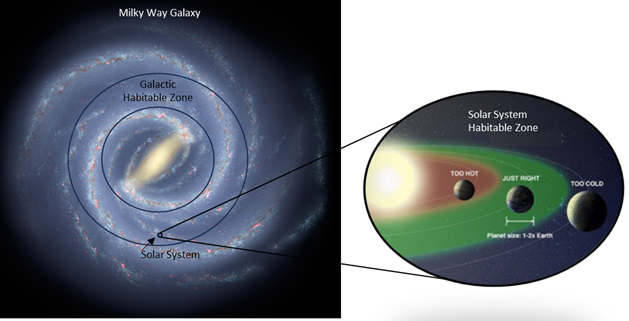
Zooming into a portion of the GHZ, Earth sits in the “just right” range around the Sun where liquid water can exist on the surface. This region is the stellar habitable zone (or, as NASA explains, “the distance from a star at which liquid water could exist on orbiting planets’ surfaces”[3]). The habitable zone depends on stellar size: too close brings excessive X‑ray and ultraviolet radiation; too far provides insufficient heat.
Earth is fortunate to be in the right place both in the galaxy and in the solar system to sustain life. One nearby planet, Jupiter, is about eleven times Earth’s diameter and roughly 2.5 times Earth’s surface gravity; its large mass helps deflect or capture much space debris that might otherwise hit Earth. Other lucky effects are Earth’s molten, metallic outer core generates a magnetosphere that deflects and traps charged particles from the solar wind, and the ozone layer absorbs most harmful ultraviolet radiation and X‑rays before they reach the surface.

Earth’s molten, metallic outer core generates a magnetosphere that deflects and traps charged particles from the solar wind [4], and the ozone layer absorbs most harmful ultraviolet radiation and X‑rays before they reach the surface[5].
The Earth’s Moon also helps sustain life on Earth in several important ways by stabilizing Earth’s axial tilt, which reduces extreme climate swings that would challenge complex life. It also moderates tides, influencing ocean circulation and climate, and slows Earth’s rotation, creating steadier, longer days that favor stable climates and biological rhythms. Much like Jupiter, the Moon also helps protect Earth from impacts.
Besides all of the above ‘coincidences’, the universe operates by mathematical laws and constants. For example, gravity, the force that keeps it all together has to be very precise. Small changes can have big consequences. If gravity were weaker, it would not gather gas into stars before cosmic expansion diluted it and if it were stronger early collapse into dense objects and black holes would dominate.
The universe follows a set of physical laws and constants that affect whether the universe can form stars, chemistry, planets, or life. Small changes in some of those numbers would make stars, planets, or the chemistry of life impossible. Besides gravity some are:
Electromagnetism (α ≈ 1/137): Controls atoms and chemistry; modest changes would break chemistry needed for life.
Proton/electron mass ratio (mp/me): Affects molecular behavior and chemical reactions.
Strong and weak nuclear forces: Set how elements form in stars; small shifts can stop production of carbon or oxygen.
Cosmological constant (Λ): Drives cosmic expansion; if much larger, galaxies never form; if much smaller (negative), the universe could re-collapse quickly.
Primordial fluctuation size (Q ≈ 10^−5): Determines how lumpy the early universe was; too smooth or too clumpy, and habitable structures don’t form.
Together these parameters must fall within relatively narrow ranges for a universe that can produce long‑lived stars, planets, and the chemical elements life needs. This is what modern cosmologists call “fine tuning.” Astrophysicist Dr. Hugh Ross has said “. . . we happen to live in the best, perhaps the one and only, neighborhood that allows not only for physical life’s existence but also for its enduring survival.”[6] To understand this fine tuning better, let’s look at the cosmological constant. Dr. Jay Richards explains that “[t]o get the right balance, the cosmological constant must be fine-tuned to something like 1 part in 10^120. If it were just slightly more positive, the universe would fly apart; slightly negative, and the universe would collapse.”[7]
To illustrate how precise, 1 part in 10^120 has 119 zeros after the decimal point:
0.000000000000000000000000000000000000000000000000000000000000000000000000000000000000000000000000000000000000000000000001
There are so many variables that need to be “just right” that, if they were anything else, almost everyone would be suspicious that it was set up. J. Warner Wallace explains: “[s]ome have argued the apparent fine‑tuning of the universe is simply a fortuitous accident. But this explanation is logically inconsistent with the purpose of any scientific investigation (to push beyond the appearance of ‘coincidence’ to find an explanation) and completely ignores the evidence we’ve described related to the high improbabilities of fine‑tuning.” [8]
Several inferences can be drawn from the data. First, the universe could be finely tuned by physical necessity: the constants and laws could not have been otherwise. Alternatively, it could be fortuitous (mere chance) or it could be due to design, in which a purposeful agent set the constants or conditions to permit life. I leave it to you to weigh the evidence and decide which inference is most reasonable.
The heavens declare the glory of God; the skies proclaim the work of his hands. Day after day they pour forth speech; night after night they reveal knowledge. They have no speech, they use no words; no sound is heard from them. Yet their voice goes out into all the earth, their words to the ends of the world. (Psalm 19:1-3)
[1] https://www.nasa.gov/science-research/astrophysics/how-big-is-space-we-asked-a-nasa-expert-episode-61/
[2] https://science.nasa.gov/missions/hubble/hubble-reveals-observable-universe-contains-10 times-more-galaxies-than-previously-thought/
[4] https://science.nasa.gov/science-research/earth-science/earths-magnetosphere-protecting-our-planet-from-harmful-space-energy/
[5] Rettberg, Petra, and Lynn J. Rothschild. 2002. “Ultraviolet Radiation in Planetary Atmospheres and Biological Implications.” In Astrobiology, edited by Gerhard Horneck and Claudia Baumstark‑Khan, 1–20. Berlin: Springer.
[6] Hugh Ross, Improbable Planet: How Earth Became Humanity’s Home (Grand Rapids, MI: Baker Books, 2016), 27.
[8] J Warner Wallace, God’s Crime Scene: A Cold Case Detective Examines the Evidence for a Divinely Created Universe (Colorado Springs, CO: David C. Cook, 2015), 62-63.



Comments