
From Nazareth to the World: Why Jesus’s Claims Matter
Jesus of Nazareth is the most written‑about and influential person in history. Secular New Testament scholar Dr. Bart Ehrman states, “There can be no doubt that Jesus of Nazareth has been the most influential person in the history of the world.” [1] Besides Ehrman’s endorsement, Jesus has been on the cover of Time magazine twenty‑one times.[2] Thích Nhất Hạnh, the Vietnamese Zen Buddhist monk, has said, “I call Jesus a bodhisattva, an enlightened being with great compassion.” [3] Muslims revere Jesus as a prophet and messenger who was sent to the children of Israel with scripture and guidance (Qur’an 3:49). And although most Jewish Talmudic and Mishnaic texts dating back to 500 CE are more hostile to Jesus (Yeshu), there are still Jewish scholars such as Géza Vermes who viewed Jesus as an itinerant Jewish teacher whose ethical teachings and parables fit within Jewish prophetic and wisdom traditions.[4]
Even outside religious contexts, Jesus’ moral teachings have commanded deep respect. Thomas Jefferson,

who rejected the Trinity and Jesus’ divinity,[5] nonetheless wrote, “I am a real Christian, that is to say, a disciple of the doctrines of Jesus.”[6] Jefferson thought highly of Jesus’ moral teachings: “A more beautiful or precious morsel of ethics I have never seen.” [7] Jefferson’s admiration underscores a striking pattern: even those who do not accept Christian theology often find Jesus’ character and teachings compelling.
From a purely naturalistic standpoint, Jesus’ life is the kind that typically disappears into history. He was born in the quiet little town of Bethlehem, lived a very humble life, and His ministry lasted only three and a half years. During this time, He never traveled outside of Israel and moved in a small circuit between Nazareth, Capernaum, Cana, Chorazin, Bethsaida, and the surrounding villages. He sometimes went to Jerusalem, and His longer‑distance trips took him to Tyre, Sidon, and the Decapolis, but rarely more than one hundred and twenty miles in any direction. Many people in the first century claimed to be messiah‑like figures, and almost none left more than a faint trace in the historical record. Jesus is the overwhelming exception. So why is He so different?
Historical facts alone cannot explain Jesus’ extraordinary impact. Countless teachers, prophets, and revolutionaries lived in the first century, yet almost none reshaped the world. The difference lies, not just in what Jesus taught, but in what He claimed about Himself. To understand His influence, we must look not only at His historical context but also at the claims preserved in the New Testament, claims so unprecedented within Judaism that they demand an explanation.
But Jesus did not merely travel around teaching morals in parables. In a synagogue in Nazareth, Scripture tells us that “. . . He was handed the book of the prophet Isaiah. And when He had opened the book, He found the place where it was written:
“The Spirit of the Lord is on Me,
Because He has anointed Me
To preach the gospel to the poor.
He has sent Me to heal the brokenhearted,
To proclaim liberty to the captives
and recovery of sight for the blind,
To set at liberty those who are oppressed;
To proclaim the acceptable year of the Lord.”
Then He closed the book, and gave it back to the attendant and sat down. And the eyes of all who were in the synagogue were fixed on Him. 21 And He began to say to them, “Today this Scripture is fulfilled in your hearing” (Luke 4:17–21 ESV).
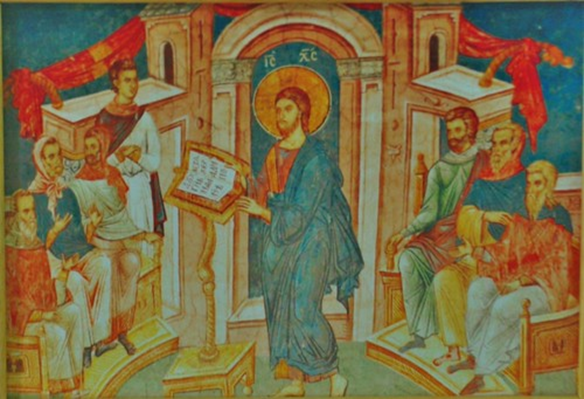
Jesus seems to have believed that the Spirit of the Lord was upon Him and that Isaiah’s centuries‑old prophecy was being fulfilled through Him. Jesus also made many prophecies Himself. Jesus did not speak like the prophets who came before Him. They said phrases such as, “Thus says the Lord.” Whereas Jesus said, “Truly, truly, I say to you.” He placed His own words on the level of divine revelation. For instance, in John 1:51 Jesus says, “Truly, truly, I tell you, you will see heaven open and the angels of God ascending and descending on the Son of Man.” These are the claims of someone who believed He stood in the place of God Himself.
In another instance, Jesus was answering the Pharisee’s question: “Your father Abraham rejoiced that he would see my day. He saw it and was glad.” So, the Jews said to Him, “You are not yet fifty years old, and have you seen Abraham?” Jesus said to them, “Truly, truly, I say to you, before Abraham was, I am.” So they picked up stones to throw at him, but Jesus hid Himself and went out of the temple” (John 8:56–59 ESV). Here Jesus used the same name that God used for Himself in Exodus 3:14 — “I AM.” “Those who suggest that Jesus never actually claimed to be God should consider the reaction of the religious leaders to His words, shown in the next verse. They are so enraged that they attempt to stone Jesus right then and there.”[8]
If the above was not radical enough, in Mark 2:1–12 a paralytic is brought before Jesus, and Jesus tells him, “Your sins are forgiven.” The Pharisees respond, “Why does this man speak blasphemies like this? Who can forgive sins but God alone?” In Judaism, sins are offenses against God, and only God can forgive them. In John 10:30, Jesus says, “I and the Father are one,” in response to questioning by some Jewish leaders at the Temple in Jerusalem. Their immediate reaction was to pick up stones to stone Him. Why? Because they interpreted His words as blasphemy—a claim to divine unity.
So, if the New Testament records all of these things, how can anyone say that He was merely a good teacher? C. S. Lewis tackles this in Mere Christianity:
I am trying here to prevent anyone saying the really foolish thing that people often say about Him: I'm ready to accept Jesus as a great moral teacher, but I don't accept his claim to be God. That is the one thing we must not say. A man who was merely a man and said the sort of things Jesus said would not be a great moral teacher. He would either be a lunatic—on the level with the man who says he is a poached egg—or else he would be the Devil of Hell. You must make your choice. Either this man was, and is, the Son of God, or else a madman or something worse. You can shut him up for a fool, you can spit at him and kill him as a demon or you can fall at his feet and call him Lord and God, but let us not come with any patronizing nonsense about his being a great human teacher.[9]
From the evidence of Jesus teachings, the choices we have to figure Him out are: Lunatic, Liar, or Lord.
Across cultures, religions, and centuries, Jesus of Nazareth stands alone. His influence cannot be explained by His humble origins, short ministry, or limited geographic reach. Nor can it be contained within the category of “moral teacher,” for He claimed far more than that, He claimed divine authority, fulfilled prophecy, and spoke as the very voice of God. As C. S. Lewis argued, Jesus did not leave open the option of mild admiration. His words and actions force a decision. Either He was deceived, deceptive, or exactly who He said He was. And if the testimony of history, Scripture, and billions of transformed lives is any indication, the most reasonable conclusion is that Jesus is not merely a great teacher, but the Lord He claimed to be.
[3] Thích Nhất Hạnh. Living Buddha, Living Christ. New York: Riverhead Books, 1995. Page 3?
[4] Géza Vermes, Jesus the Jew: A Historian’s Reading of the Gospels, rev. ed. (London: Collins, 1977; U.S. ed. Minneapolis: Fortress Press, 1979)
[6] Thomas Jeffereson, The Jefferson Bible: The life and Morals of Jesus of Nazareth (Mineola, NY: Dover Publications, 2006), 12.
[7] Jeffereson, The Jefferson Bible, 12.
[9] C.S. Lewis, Mere Christianity (New York, NY: Harper Colins, 1952), 52.


Comments